
Screw Press Sludge Dewatering Commissioning: A Technical Guide to Acceptance Criteria
Commissioning & Acceptance Guide
Commissioning is the point where a screw press sludge dewatering machine stops being a quotation and starts becoming a working asset. It is also the point where poorly defined purchasing terms become expensive arguments. A machine can pass a factory run and still fail site acceptance if the sludge basis, scope of supply, polymer dosing, or handover evidence was never fixed in the purchase order.
This guide gives buyers, plant engineers, and project managers a step-by-step framework for commissioning a screw press sludge dewatering machine. It links commercial terms to technical acceptance criteria, explains how to interpret published parameters, and shows where common commissioning gaps appear. The same framework applies to a single sludge dewatering unit and to a complete sludge dewatering system with feed pumping, polymer dosing, controls, and cake conveying.
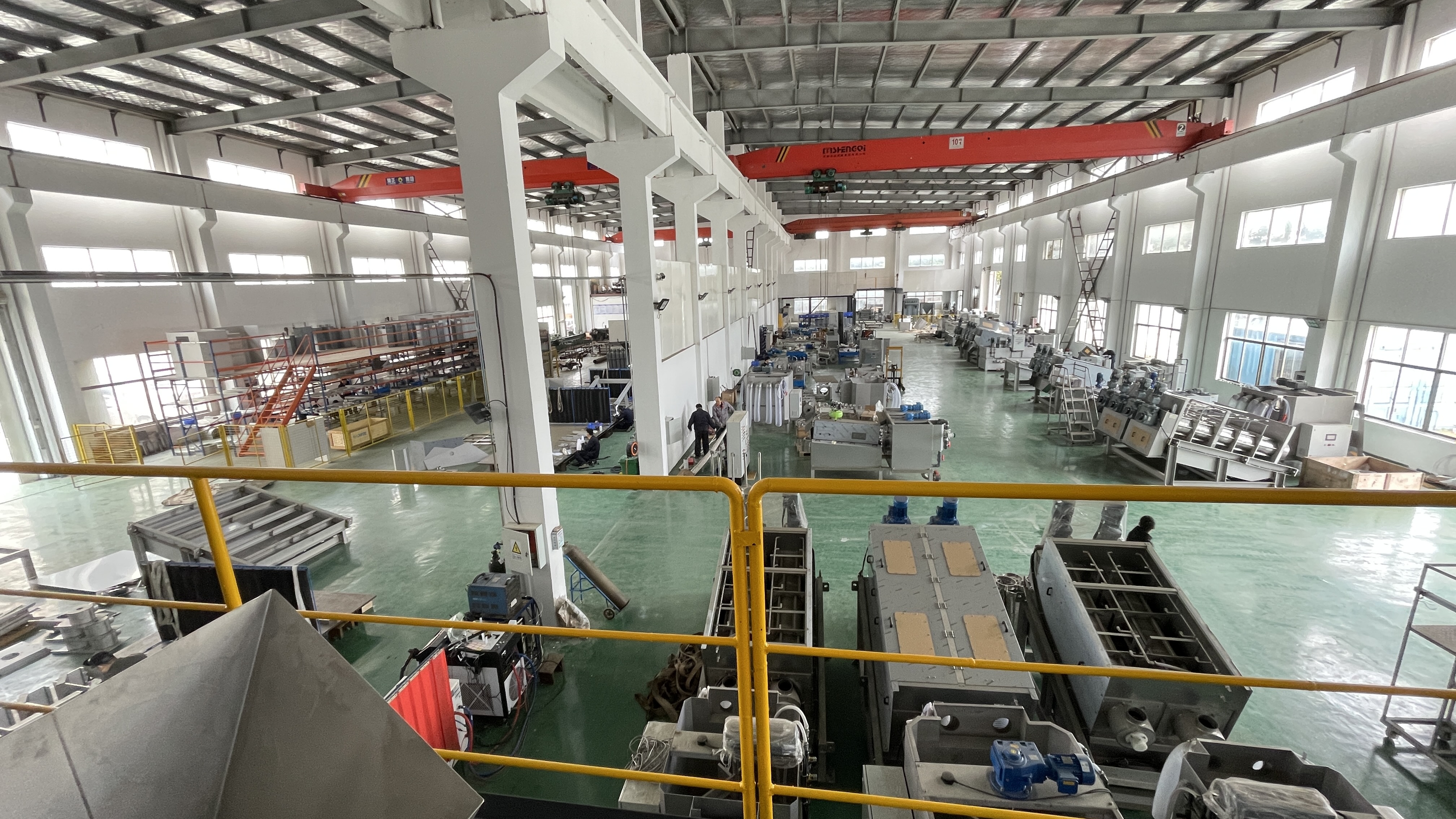
Benenv assembly workshop. Factory assembly is where the mechanical and control checks behind a factory acceptance test begin.
Problem Definition: Why Commissioning Disputes Happen
Most commissioning disputes are not caused by a broken machine. They are caused by an undefined test basis. A screw press for sludge dewatering can be described by hydraulic capacity in cubic metres per hour or by dry-solids capacity in kilograms per hour. Those are different measurements. If the purchase order does not state which one is guaranteed, and under what inlet concentration, polymer dose, and target cake dryness, the acceptance test has no common reference point.
A published Benenv MDS101 product listing illustrates the issue. It reports a dry-solids capacity of 3–6 kg/h and a hydraulic treatment capacity of 0.12–1.5 m³/h across reported sludge concentrations of 2,000 to 50,000 mg/L. Those figures are manufacturer-reported and require confirmation of concentration basis and test conditions. They are useful for sizing discussion, but they cannot be used as a site acceptance guarantee unless the feed sludge and test protocol are defined.
The second common gap is scope. A screw press dehydrator is often quoted as a machine, while the operating system also needs a sludge feed pump, PAM dosing system, PLC control cabinet, and cake conveying system. If those items sit outside the battery limits, commissioning can stall while buyers and suppliers debate who supplies the missing interface.
The third gap is commercial. The provided purchasing terms for Benenv equipment list MOQ 1 unit, delivery terms FOB/CIF/EXW/DDP, payment terms 40/60 TT, and acceptance criteria of pre-shipment test and FAT inspection. Those terms are clear, but they only work if the pre-shipment test and FAT inspection are tied to defined technical evidence and a handover sequence. Otherwise, the final payment can be released before the site performance is demonstrated.
Commissioning rule: do not accept a screw press sludge dewatering machine on a single capacity number. Accept it on a defined sludge basis, a defined scope of supply, a witnessed factory test, a site commissioning record, and a performance check against the same basis.
Industry Background: Growth Makes Acceptance Discipline More Important
The global sludge dewatering equipment market was valued at USD 5.19 billion in 2024, according to Fortune Business Insights. The screw press segment is projected to grow at a 9.4% CAGR over the 2025–2032 forecast period, and Asia Pacific held a 37.57% revenue share in 2024. These figures explain why more buyers are entering the category, but they do not make every published capacity claim directly comparable.
Screw press technology is selected for reasons that matter at commissioning: low energy consumption, low maintenance requirements, a clog-free self-cleaning design, fully automatic operation, a compact footprint, low noise operation, continuous dewatering, and reduced sludge disposal cost. Published comparisons also point to up to 30–50% energy savings, footprint reduction of up to 50%, and maintenance frequency reduction of 30–60% versus centrifuges, with a cost difference of 30–50% lower than centrifuges. These are category-level claims. The site result depends on how well the unit is commissioned against the actual sludge.
Benenv (JIANGSU BENENV ENVIRONMENTAL TECHNOLOGIES CO., LTD) is a China-based environmental equipment manufacturer founded in 2011, with a 20,000 m² factory, about 200 employees, and a product portfolio that includes the MDS multi-disk screw press for sludge dewatering and solid-liquid separation. The company reports more than 4,500 project references in more than 60 countries and 18 agents in countries including France, the United States, the United Kingdom, Malaysia, Indonesia, and Saudi Arabia. That installed base is useful context for spare-parts and service discussions, but it does not replace project-specific acceptance evidence.
A 2025 aggregate research estimate cited an average selling price of USD 46,000 per unit for a sludge screw dewatering press. That figure is a market benchmark, not a quotation. Price changes with model size, materials, automation scope, polymer dosing, and the boundary of the sludge dewatering system.
Detailed Solution: Build Acceptance Around Four Gates
A defensible commissioning process has four gates. Each gate produces evidence that the next gate depends on. The gates apply to a screw press dewatering device, a screw type sludge dehydrator, or a full industrial sludge dewatering machine.
Gate 1: Commercial and technical basis in the purchase order
The purchase order should freeze the sludge basis, the scope of supply, the test method, and the acceptance criteria. At minimum, the technical annex should define the sludge type, inlet solids concentration, volatile solids, oil and grease content, viscosity, pH, temperature, polymer type and dose range, target cake dry-solids content, operating pattern, and the guaranteed capacity basis. These are project-specific values. The corpus does not provide universal setpoints, and no supplier should be allowed to substitute a generic capacity table for a project-specific basis.
Gate 2: Pre-shipment test and factory acceptance test
The stated acceptance criteria are a pre-shipment test and FAT inspection. The FAT should verify mechanical operation, rotation, noise and vibration, leak tightness, PLC input and output, emergency stop, polymer dosing pump calibration, backwash sequence, and material verification where SS304 or SS316 is specified. The test should also confirm the scope of supply: feed pump, PAM dosing system, PLC control cabinet, and cake conveying system where included.
Model-specific utility data should be confirmed at this stage. A Benenv marketplace listing reports, for selected MDS models, installed power and backwash-water figures including MDS131 at 0.2 kW and 24 L/h, MDS132 at 0.3 kW and 48 L/h, MDS202 at 0.8 kW and 64 L/h, MDS311 at 0.8 kW and 40 L/h, MDS312 at 1.2 kW and 80 L/h, MDS313 at 1.95 kW and 120 L/h, MDS412 at 3.75 kW and 144 L/h, and MDS413 at 6.0 kW and 216 L/h. These are listing-reported values and should be confirmed against the current model datasheet and the actual quotation.
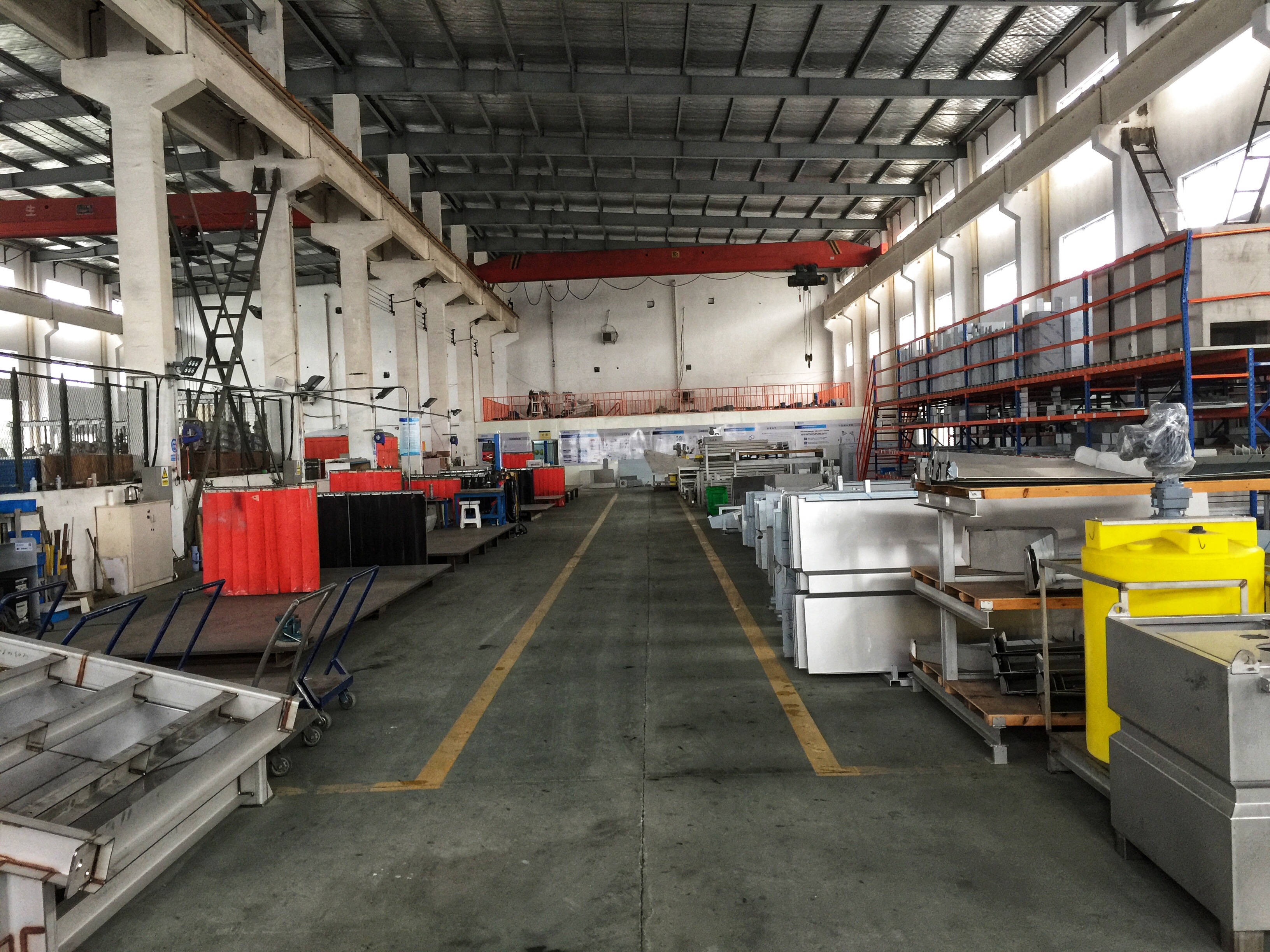
Benenv welding workshop. Fabrication checks and material verification belong in the factory acceptance evidence, not only in the site commissioning file.
Gate 3: Site mechanical completion and process commissioning
Site acceptance starts with mechanical completion: foundation, leveling, pipe connections, electrical termination, rotation direction, lubrication, guarding, drainage, ventilation, and access. The unit should then be commissioned with a controlled feed. Polymer dosing should be optimized, operating parameters adjusted, and the self-cleaning and continuous washing functions observed under realistic feed conditions. PLC-based automatic control and real-time adjustment should be demonstrated, not just described.
Sludge variability is the main process risk. Variation in concentration, oil content, and viscosity can change dewatering performance. The control response is to optimize polymer dosing and adjust operating parameters, not to force the machine beyond its design basis. Unstable sludge feed or impurities can cause clogging; the self-cleaning design and continuous washing system are the relevant controls. Wear of the screw shaft and moving rings is another long-term risk, managed through low-speed operation, wear-resistant materials, maintenance plans, and spare-parts supply.
Gate 4: Performance acceptance and handover
Performance acceptance should compare actual results with the guaranteed values using the same sludge basis and sampling method defined in Gate 1. The record should include feed rate, inlet solids, polymer dose, cake dry-solids content, backwash water, power, and runtime. If a result is outside the agreed range, the review should separate feed variability, polymer selection, mechanical condition, control settings, and scope gaps before assigning responsibility.
Handover is not only a manual. It is the package that lets the plant operate and maintain the unit: FAT report, pre-shipment test records, material certificates, PLC program backup, O&M manual, spare-parts list, and training records. For long-term operation, the supplier's service model matters as much as the initial commissioning. Benenv's stated support measures include automation solutions, remote technical support, maintenance plans, and spare-parts supply. Those commitments should be written into the commercial documents if they are required for the project.
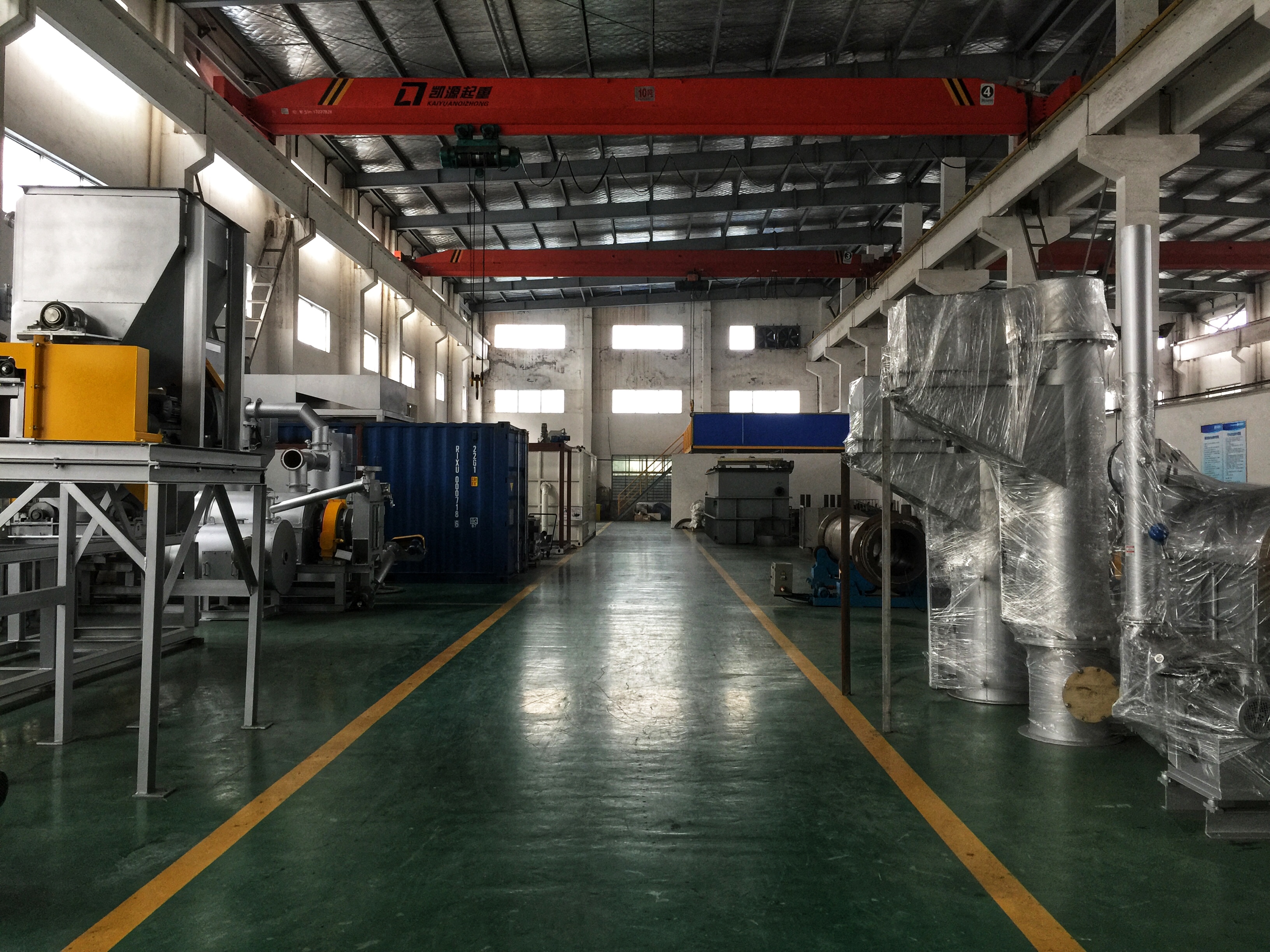
Benenv non-standard workshop. Custom engineering must be matched by a project-specific commissioning and acceptance plan.
Step-by-Step Breakdown: Commissioning and Acceptance Framework
Step 1: Write the sludge basis before the RFQ is finalized
Define the sludge source and variability. For municipal sludge dewatering, record the range of inlet solids and the expected seasonal variation. For industrial sludge dewatering, record the process source, oil and grease, pH, and any intermittent discharge. For DAF sludge dewatering, record the flotation chemistry and solids load. The objective is not a single grab sample; it is a feed envelope that the screw press sludge dewatering machine must handle.
Step 2: Freeze the scope of supply and utility schedule
List every item inside and outside the battery limits. Confirm the feed pump, PAM dosing system, PLC control cabinet, and cake conveyor. Confirm power supply, wash water, drain, ventilation, and access. Confirm which model-specific power and backwash-water figures apply. A missing auxiliary is easier to fix before shipment than during site commissioning.
Step 3: Witness the pre-shipment test and FAT
Use a written FAT agenda. Check mechanical assembly, rotation, noise, vibration, leak tightness, PLC sequence, emergency stop, polymer dosing calibration, backwash, and material traceability. Record the results against the purchase-order specification. If the FAT cannot use representative sludge, state clearly that site performance acceptance will be the decisive test and define how it will be run.
Step 4: Complete site mechanical checks
Verify installation against the approved drawings. Check alignment, piping, electrical connections, rotation direction, lubrication, guarding, drainage, and ventilation. Confirm that the sludge feed and polymer dosing lines are clean and that the control cabinet is protected from moisture and dust. Confirm that the drainage and cake handling routes are ready before sludge is introduced.
Step 5: Commission with controlled feed and record the baseline
Start with a controlled feed and gradually increase to the design range. Optimize polymer dosing. Observe the self-cleaning action and continuous washing. Record feed rate, inlet solids, polymer dose, cake dry-solids content, backwash water, power, and runtime. Use a sampling plan rather than a single sample. The baseline record becomes the reference for performance acceptance and future troubleshooting.
Step 6: Run performance acceptance and close the handover
Compare the baseline with the guaranteed values. Confirm the capacity basis: hydraulic capacity in m³/h, dry-solids capacity in kg/h DS, or both. Confirm the target cake dryness and polymer consumption. Review the FAT report, site records, PLC settings, material certificates, and O&M documents. Only then close the acceptance certificate and the commercial handover.

Benenv group. Long-term service support should be defined in the handover package, not left as an informal promise.
Use Cases: Where Acceptance Criteria Change
Municipal sludge dewatering system. Feed varies with season, stormwater, and plant operation. Acceptance should use a feed envelope and a sampling plan, not a single day of operation. The continuous dewatering design and automatic operation are useful only if the control response is commissioned against the actual variability.
Industrial sludge dewatering machine. Chemical, textile, paper, pharmaceutical, and agricultural wastewater streams can differ sharply in solids, oil, and viscosity. The acceptance basis should be tied to the specific industrial stream. A machine that performs on one stream is not automatically accepted on another.
DAF sludge dewatering. Dissolved air flotation sludge can be light and variable. The commissioning plan should confirm polymer selection, feed control, and cake handling. The same screw press dewatering device may need different settings from a biological sludge application.
Small and decentralized plants. Screw presses are described as ideal for small and decentralized plants because of their compact footprint, low noise, and simple operation. For these sites, the acceptance test should also confirm that the automatic control and remote support model fit the available operating staff.
Food processing wastewater treatment. Food processing sludge can vary with production shifts. The commissioning record should capture the operating pattern and the polymer dose range, not only the peak capacity.
Comparison Table: Acceptance Gates and Common Gaps
| Acceptance gate | What is verified | Evidence to retain | Common commissioning gap |
|---|---|---|---|
| Purchase-order basis | Sludge type, inlet solids, polymer dose range, target cake dryness, scope of supply, capacity basis | Signed technical annex, P&ID, utility schedule | Capacity quoted without a concentration basis |
| Pre-shipment test / FAT | Mechanical operation, PLC sequence, polymer dosing, backwash, leak check, material verification | FAT report, test records, material certificates | FAT does not represent site sludge |
| Site mechanical completion | Installation, alignment, piping, electrical, guarding, drainage, ventilation | Check sheets, as-built drawings | Auxiliary equipment outside the battery limits |
| Process commissioning | Feed control, polymer optimization, self-cleaning, automatic control, cake handling | Trend logs, polymer dose records, cake solids samples | Single-sample acceptance |
| Performance acceptance and handover | Guaranteed values versus actual, documentation, training, spare-parts list | Acceptance certificate, O&M manual, PLC backup | Payment released before performance verification |
The table is an acceptance framework based on the purchasing terms and technical facts in the provided corpus. It does not replace project-specific guarantees.
FAQ
What acceptance documents should be verified before a screw press is handed over?
Verify the pre-shipment test records and FAT inspection records that are named as acceptance criteria. Also request material certificates for SS304 or SS316 where specified, a PLC program backup, the O&M manual, and the certificate number, issuing body, scope, and validity for any ISO 9000 or CE claim. A marketplace listing that reports ISO 9000 and CE certificate claims is not the same as verified compliance. ISO 9000 is not a product-specific certification standard, so the scope of any certificate should be checked against the equipment being supplied.
How should capacity be tested during commissioning?
Define the sludge basis first, then distinguish hydraulic capacity in m³/h from dry-solids capacity in kg/h DS. A published Benenv MDS101 product listing reports 3–6 kg/h DS and 0.12–1.5 m³/h across 2,000–50,000 mg/L; the concentration basis and test conditions must be confirmed before acceptance. HUBER's official Q-PRESS page reports feed capacity up to 540 kg dry solids per hour for its series. These are different product ranges with different published bases, so they should not be ranked against each other without a common test protocol.
What commercial terms are linked to acceptance?
The provided purchasing terms list MOQ 1 unit, delivery terms FOB/CIF/EXW/DDP, payment terms 40/60 TT, and acceptance criteria of pre-shipment test and FAT inspection. The purchase order should map the balance payment to the agreed pre-shipment and FAT evidence, and it should state what happens if site performance does not meet the agreed basis. The 2025 average selling price estimate of USD 46,000 per unit is a market benchmark, not a quotation.
What records should be retained from commissioning?
Retain the FAT report, pre-shipment test records, material certificates, PLC settings and program backup, polymer dosing records, feed rate and inlet solids logs, cake dry-solids results, backwash-water records, power and runtime data, and the acceptance certificate. These records support warranty discussions, spare-parts planning, and future optimization. They also make the acceptance decision traceable instead of dependent on memory.
How does commissioning affect lead time and handover?
The corpus does not provide a standard lead time for a screw press sludge dewatering machine. Delivery terms such as FOB, CIF, EXW, or DDP define freight and transfer, not commissioning duration. A practical sequence is pre-shipment test and FAT, then site mechanical completion, process commissioning, and performance acceptance before final handover. To request a model-specific commissioning checklist and FAT agenda, contact Benenv at manager@benenv.com, +86 18921318788, or WhatsApp +86 12138541513.
Conclusion: Acceptance Is a Chain, Not a Signature
Commissioning a screw press sludge dewatering machine is a controlled evidence process. The buyer who defines the sludge basis, freezes the scope of supply, witnesses the pre-shipment test and FAT, records the site baseline, and ties performance acceptance to the same basis has a defensible handover. The buyer who accepts on a single capacity number or a factory run alone inherits the commissioning risk.
The framework applies to a screw press dehydrator, a screw type sludge dehydrator, a dewatering screw press machine, or a complete sludge dewatering system. The equipment category is growing, and published claims are multiplying. Acceptance discipline is how a buyer separates a useful specification from a commercial promise.
Request a Commissioning Checklist or Project Review
Benenv supplies the MDS multi-disk screw press and related sludge dewatering systems for municipal and industrial wastewater treatment. For a model-specific commissioning checklist, FAT agenda, or quotation review, contact the Benenv team.
Email: manager@benenv.com | Tel: +86 18921318788 | WhatsApp: +86 12138541513
Website: en.benenv.com
Download the brochure: Benenv product brochure (PDF)

Benenv group. Commissioning support and long-term service should be part of the documented handover.
Source notes: market size, CAGR, regional share, and average selling price are from the verified data package (Fortune Business Insights, Grand View Research, and aggregate commercial research). Product and company facts are from the provided Benenv corpus and verified data. Manufacturer-reported capacity and utility figures require confirmation against the current model datasheet and project-specific test protocol.
Have Questions or Need More Details?
Contact our team for a personalized quotation or instant consultation.
Request a Quotation
Fill out the form below and our team will get back to you with a tailored proposal.
WhatsApp Direct Chat
Prefer to chat in real-time? Message us on WhatsApp for instant assistance & quick answers.
- Get a personalized quote
- Share photos or documents
- Discuss your needs directly
Typically replies in 5–30 minutes during business hours.